
Logically
Choose the best IT support option below.


The State of Cybersecurity in 2026: What Modern Businesses Must Get Right
Cybersecurity in 2026 looks nothing like it did even a year ago. The digital environment is expanding faster than most organizations can secure, and attackers are accelerating even faster. Global cybersecurity investment is on track to exceed $240 billion, driven by the need to protect cloud platforms, AI-powered workloads, and increasingly distributed teams.
Cybersecurity in 2026 looks nothing like it did even a year ago. The digital environment is expanding faster than most organizations can secure, and attackers are accelerating even faster. Global cybersecurity investment is on track to exceed $240 billion, driven by the need to protect cloud platforms, AI-powered workloads, and increasingly distributed teams.
Read full post on go.logically.com
Why Cyber Insurance Has Become Essential in the Mid-Market
Mid-market organizations face the same attack patterns as large enterprises but without the scale or redundancy to absorb disruption. Most operate with limited security engineering capacity and shared responsibility models across internal teams and service providers. As environments expand through SaaS, remote work, and third-party integrations, attack surfaces have grown faster than headcount. At the same time, breach costs have accelerated. Organizations often absorb expenses related to: Legal counsel and regulatory response Forensics and containment Operational downtime Data rest
Mid-market organizations face the same attack patterns as large enterprises but without the scale or redundancy to absorb disruption. Most operate with limited security engineering capacity and shared responsibility models across internal teams and service providers. As environments expand through SaaS, remote work, and third-party integrations, attack surfaces have grown faster than headcount. At the same time, breach costs have accelerated. Organizations often absorb expenses related to: Legal counsel and regulatory response Forensics and containment Operational downtime Data restoration Customer notification and support Contractual disputes Reputational damage and churn Large enterprises can often dilute these impacts. Mid-market companies cannot. A single incident may disrupt cash flow, delay customer deliverables, or affect contractual obligations. Boards now expect clear prevention strategies and defined financial resilience plans. Cyber insurance sits at the center of those expectations. How Today’s Cyber Insurance Market Evolved Cyber policies originally focused on third-party liability. As threats escalated, insurers added coverage for business interruption, data restoration, and incident management. Cloud adoption, remote work, and targeted ransomware further tightened underwriting requirements. The biggest shift today is insurer scrutiny. Carriers now demand proof that core controls are implemented, monitored, and documented. Gaps or outdated practices often lead to higher premiums, reduced limits, or limited eligibility. For mid-market organizations, cyber insurance now acts as both a financial backstop and a direct incentive to strengthen foundational security. Rising Regulatory Pressures Increase the Value of Coverage Regulatory expectations continue to expand. Privacy laws (HIPAA, GDPR, state privacy acts), critical infrastructure rules, and incident reporting requirements all shape how organizations must respond after a breach. Public companies face additional SEC disclosure obligations. After an incident, teams may need to execute mandatory notifications, produce investigation reports, demonstrate remediation, and coordinate with regulators. These activities require specialized technical and legal expertise. Cyber insurance helps fund these efforts—subject to policy terms—and provides access to breach counsel, forensic firms, and vetted IR partners. For mid-market teams without deep in-house resources, this support is often essential to maintaining continuity. How Underwriters Evaluate Your Environment Underwriting is now a structured assessment of your security posture. Most carriers expect documented, functioning controls. Key areas influencing pricing and eligibility include: Identity and Access Management MFA for administrative and remote access Privileged access management or equivalent processes Regular access reviews and removal of stale accounts Endpoint and Server Protection Modern EDR/XDR with centralized monitoring Patch management with defined timelines Log retention with visibility for internal teams or your MSSP Backup and Recovery Backups isolated from production Support for immutability or write-once storage Documented and tested recovery procedures Network and Cloud Configuration Segmentation for critical systems Secure remote access Clearly defined MSP/MSSP responsibilities Incident Response A written and tested IR plan Defined escalation paths with MSP/MSSP partners Evidence of tabletop exercises Organizations able to demonstrate strong, well-documented controls typically earn better pricing and broader coverage. First-Party vs. Third-Party Coverage: What Each Protects Understanding coverage categories helps determine whether your policy aligns with your risk profile. First-Party Coverage Protects your organization’s direct losses, such as: Incident response and forensics Data restoration and system recovery Business interruption costs Notification and call center operations Credit monitoring Crisis communications Certain regulatory fines (where allowed) Extortion response costs Example: A ransomware attack halts production and encrypts data. First-party coverage funds containment, recovery, restoration, and lost income during downtime. Third-Party Liability Coverage Applies when external parties claim your organization caused them harm. Often includes: Legal defense Settlements or judgments Contractual liability Privacy or regulatory claims brought by external entities This is especially relevant when MSP/MSSP partners are involved. Misconfigurations, missed alerts, or unclear responsibility boundaries can expose organizations to customer or partner claims. Most mid-market companies require both types of coverage to address their full risk landscape. What Cyber Insurance Covers — and What It Excludes While policies vary by carrier, most comprehensive policies include: Typically Covered Incident response and forensics Data restoration Business interruption and extra expenses Notification and credit monitoring Legal and regulatory defense Crisis communications Certain extortion payments Access to vetted IR firms Common Exclusions Physical injury or property damage Loss of physical devices Fraud or criminal acts by the insured Failures driven by utility outages Claims arising when required controls were not maintained Acts of war or nation-state activity (depending on carrier) Mid-market leaders should review policy language in partnership with brokers, counsel, and MSP/MSSP teams to ensure alignment across responsibilities and insurer expectations. How Insurers Price Policies in the Mid-Market Premiums vary widely based on business profile and control maturity. Key Pricing Factors Organizational Characteristics Revenue Industry risk profile Volume/sensitivity of data Geographic footprint Security PostureProof of: MFA Centralized EDR/XDR Secure remote access Network segmentation Validated backups Vendor risk management Third-Party DependenciesInsurers assess: MSP/MSSP access models Shared responsibility documentation Contractual security requirements Claims History + Requested LimitsPast incidents and higher limits influence price. Most mid-market organizations pay from several thousand dollars to tens of thousands annually, depending on maturity and exposure. Deductibles, Limits, and Structuring Coverage Three financial levers anchor cyber insurance planning: DeductibleYour up-front cost before reimbursement begins. Coverage LimitsThe maximum the insurer pays during the policy period. Mid-market companies often start with $1M–$3M and adjust based on regulatory and contractual obligations. SublimitsLower caps for specific categories (e.g., extortion, business interruption). Sublimits significantly affect real incident support. Align these elements with finance, legal, and risk stakeholders to ensure coverage reflects your risk tolerance. The Role of MSPs and MSSPs in Cyber Insurance Readiness For many mid-market organizations, MSP/MSSP partners are central to meeting security and underwriting requirements. Their support directly influences documentation quality, visibility, and response maturity. Where MSP/MSSP Partnerships Add Value Implementing and maintaining required controls Managing EDR tooling and alerting Ensuring backups are functional and tested Supporting IR plan development and exercises Providing evidence for underwriting Delivering 24×7 monitoring and escalation Maintaining documentation insurers often request Where Leaders Need Clarity Carriers often ask: Who owns patching and hardening? Who manages identity governance? How is privileged access handled across MSP boundaries? What logs are collected, retained, and monitored? How quickly can the MSP/MSSP escalate or contain incidents? A documented shared responsibility model reduces risk and eliminates ambiguity during underwriting or incident response. Using Cyber Insurance and Security Together Cyber insurance is not a substitute for strong controls, nor does it guarantee full reimbursement. It is most effective when aligned with a mature security program. Security controls reduce likelihood and impact. Insurance reduces financial volatility. MSP/MSSP partners operationalize both. The most resilient mid-market organizations maintain strong baselines, document responsibilities clearly, integrate MSP/MSSP teams into IR planning, and use insurance to absorb residual risk. This balanced approach builds leadership confidence and strengthens overall resilience. Final Thought Cyber insurance has become a strategic tool for mid-market technology leaders. It shapes budgeting, informs security investments, and strengthens board communication. When security controls, operational processes, and insurance planning work together, organizations respond faster, maintain continuity, and limit financial exposure. Strengthen Your Cyber Insurance Readiness With Logically If you want clearer visibility into your risk posture or help aligning your controls with insurer expectations, Logically can support you. We partner with mid-market technology and security teams to: Validate your current control environment Strengthen the controls insurers prioritize Improve documentation and shared responsibility models Reduce operational risk and improve insurability Enhance IR planning across MSP/MSSP ecosystems To discuss your insurance readiness, connect with Logically. A short conversation can help you understand your current position and identify the steps that will deliver the greatest reduction in risk and exposure. Additional Resources From Logically For more guidance as you prepare for coverage evaluations or underwriting: Cysurance & Logically Partnership — Integrated cyber protection and insurability solutions Cybersecurity Coverage Guide — How insurability shapes cybersecurity priorities Understanding Cybersecurity Insurance for SMBs — Practical background for smaller teams
Read full post on go.logically.com
Beyond Pilot: The Strategic Framework for Scaling M365 Copilot Adoption
We've watched enough M365 Copilot deployments to spot the pattern. Some organizations get immediate value. Others accumulate licenses that sit idle while everyone quietly wonders what went wrong. The difference isn't luck; it's following a framework that puts business value ahead of technology excitement. Here's the step-by-step approach that consistently delivers results.
We've watched enough M365 Copilot deployments to spot the pattern. Some organizations get immediate value. Others accumulate licenses that sit idle while everyone quietly wonders what went wrong. The difference isn't luck; it's following a framework that puts business value ahead of technology excitement. Here's the step-by-step approach that consistently delivers results.
Read full post on go.logically.com
Logically Uncovered Webinar Series - Hacking Healthcare IT Budgets
Join Logically’s cybersecurity experts VP of Cybersecurity, Zack Finstad, and Network Security Manager, Kyle Sandy, for an insightful webinar designed to help you fortify your network against threats and protecting your firewall from increased brute force attacks. Cybersecurity threats are constantly evolving, and staying ahead of them is critical to safeguarding your business. Recently, there has been a significant rise in brute force attacks targeting firewalls across industries. These attacks exploit open ports, such as those used for SSL VPNs, to repeatedly guess login credentials
Join Logically’s cybersecurity experts VP of Cybersecurity, Zack Finstad, and Network Security Manager, Kyle Sandy, for an insightful webinar designed to help you fortify your network against threats and protecting your firewall from increased brute force attacks. Cybersecurity threats are constantly evolving, and staying ahead of them is critical to safeguarding your business. Recently, there has been a significant rise in brute force attacks targeting firewalls across industries. These attacks exploit open ports, such as those used for SSL VPNs, to repeatedly guess login credentials and gain unauthorized access to systems. We’ll dive into the nature of brute force attacks, explore their primary points of entry, and share actionable security measures you can implement to protect your infrastructure. Key topics include: Multi-Factor Authentication (MFA): How an extra layer of security can prevent unauthorized access—even if passwords are compromised. Geo-IP Filtering: Blocking high-risk regions to minimize your exposure to cybercriminals. Trusted IP Restrictions: Locking down your network to reduce vulnerability to brute force and password spraying attacks. The importance of limiting access per user on the SSL VPN to necessary resources Discover how Logically’s SentryXDR service monitors emerging threats and how we can assist you in implementing robust defenses. Don’t miss this opportunity to enhance your organization’s cybersecurity posture and keep your business safe from today’s rising threats.
Read full post on go.logically.com
Case Study: Cameron Mitchell Restaurants Transforms Network Infrastructure
Overview Cameron Mitchell Restaurants, a nationally renowned restaurant group known for providing unforgettable dining experiences, faced a modern challenge: scaling secure, high-performance network infrastructure across 74 unique locations while maintaining operational excellence. Led by Orlando Sprockel, Senior Director of IT, the company turned to managed services provider Logically to design and execute a full network and security transformation—featuring an enterprise-grade Extreme Networks deployment and SonicWall firewalls.The result: dramatically improved wireless performance, great
Overview Cameron Mitchell Restaurants, a nationally renowned restaurant group known for providing unforgettable dining experiences, faced a modern challenge: scaling secure, high-performance network infrastructure across 74 unique locations while maintaining operational excellence. Led by Orlando Sprockel, Senior Director of IT, the company turned to managed services provider Logically to design and execute a full network and security transformation—featuring an enterprise-grade Extreme Networks deployment and SonicWall firewalls.The result: dramatically improved wireless performance, greater security visibility and control, and a more flexible, scalable environment to support continued growth.
Read full post on go.logically.com
LogicON 2025 Recap: The SMB Advantage in Action
Earlier this month, over 100 IT and security leaders gathered at the Renaissance Columbus Downtown Hotel in Columbus, Ohio, for LogicON 2025—a three-day deep dive into the realities of AI governance, IT modernization, and cybersecurity.
Earlier this month, over 100 IT and security leaders gathered at the Renaissance Columbus Downtown Hotel in Columbus, Ohio, for LogicON 2025—a three-day deep dive into the realities of AI governance, IT modernization, and cybersecurity.
Read full post on go.logically.com
Cybersecurity Awareness Month: How to Build a Culture of Security That Lasts All Year
Last year, cyberattacks led to more than 1 billion stolen records, a number that continues to climb. Recent reports show that in 2025 alone, more than 53 billion identity records have already been exposed, and credential theft has surged by 160%, now accounting for one in five data breaches. For mid-market organizations, the consequences of a single incident—financial loss, reputational damage, and compliance penalties—are more devastating than ever.
Last year, cyberattacks led to more than 1 billion stolen records, a number that continues to climb. Recent reports show that in 2025 alone, more than 53 billion identity records have already been exposed, and credential theft has surged by 160%, now accounting for one in five data breaches. For mid-market organizations, the consequences of a single incident—financial loss, reputational damage, and compliance penalties—are more devastating than ever.
Read full post on go.logically.com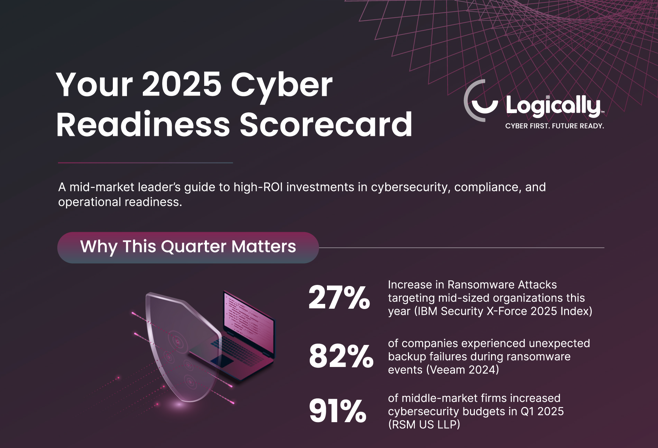
2025 Cybersecurity Readiness Scorecard
Windows 10 End of Life: What IT Leaders Must Prioritize Before October 2025
As October 14, 2025 draws near, Windows 10 support will officially end—and that date marks more than just a milestone. For IT leaders, it's the deadline for security, compliance, and operational risk. Based on our recent Logically Uncovered webinar panel with Alex Burton, Microsoft Partnership Manager, Jake Tarrant, Manager, Incident Response, and Eric Porto, Virtual Chief Information Officer, here’s what you need to know and do now to protect your organization.
As October 14, 2025 draws near, Windows 10 support will officially end—and that date marks more than just a milestone. For IT leaders, it's the deadline for security, compliance, and operational risk. Based on our recent Logically Uncovered webinar panel with Alex Burton, Microsoft Partnership Manager, Jake Tarrant, Manager, Incident Response, and Eric Porto, Virtual Chief Information Officer, here’s what you need to know and do now to protect your organization.
Read full post on go.logically.com
The Next Era of Networking: Why IT Needs a Unified Platform for the AI Age
The AI Pressure on IT Artificial Intelligence is moving from pilot projects to the backbone of enterprise strategy. IT leaders now face relentless pressure to deliver networks that are faster, more secure, and more adaptive than ever. Yet many are still running operations on fragmented tools, manual workflows, and disjointed systems that were never designed for the speed of AI adoption.
The AI Pressure on IT Artificial Intelligence is moving from pilot projects to the backbone of enterprise strategy. IT leaders now face relentless pressure to deliver networks that are faster, more secure, and more adaptive than ever. Yet many are still running operations on fragmented tools, manual workflows, and disjointed systems that were never designed for the speed of AI adoption.
Read full post on go.logically.comFailed to load more articles
You're all caught up!
Check back later for more profile news.
Our team of experts, including cybersecurity, engineering, networking, and cloud specialists, collaborate with customers to implement solutions that protect their assets, reduce risk, and optimize performance, end to end.
Since 1999, we have made long-term relationships, customer service excellence, and purposeful innovation guiding principles to ensure customers have a trusted advisor at their side, helping them focus on their business, not the technology behind it.
The State of Cybersecurity in 2026: What Modern Businesses Must Get Right
Cybersecurity in 2026 looks nothing like it did even a year ago. The digital environment is expanding faster than most organizations can secure, and attackers are accelerating even faster. Global cybersecurity investment is on track to exceed $240 billion, driven by the need to protect cloud platforms, AI-powered workloads, and increasingly distributed teams.
Cybersecurity in 2026 looks nothing like it did even a year ago. The digital environment is expanding faster than most organizations can secure, and attackers are accelerating even faster. Global cybersecurity investment is on track to exceed $240 billion, driven by the need to protect cloud platforms, AI-powered workloads, and increasingly distributed teams.
Read full post on go.logically.com
Why Cyber Insurance Has Become Essential in the Mid-Market
Mid-market organizations face the same attack patterns as large enterprises but without the scale or redundancy to absorb disruption. Most operate with limited security engineering capacity and shared responsibility models across internal teams and service providers. As environments expand through SaaS, remote work, and third-party integrations, attack surfaces have grown faster than headcount. At the same time, breach costs have accelerated. Organizations often absorb expenses related to: Legal counsel and regulatory response Forensics and containment Operational downtime Data rest
Mid-market organizations face the same attack patterns as large enterprises but without the scale or redundancy to absorb disruption. Most operate with limited security engineering capacity and shared responsibility models across internal teams and service providers. As environments expand through SaaS, remote work, and third-party integrations, attack surfaces have grown faster than headcount. At the same time, breach costs have accelerated. Organizations often absorb expenses related to: Legal counsel and regulatory response Forensics and containment Operational downtime Data restoration Customer notification and support Contractual disputes Reputational damage and churn Large enterprises can often dilute these impacts. Mid-market companies cannot. A single incident may disrupt cash flow, delay customer deliverables, or affect contractual obligations. Boards now expect clear prevention strategies and defined financial resilience plans. Cyber insurance sits at the center of those expectations. How Today’s Cyber Insurance Market Evolved Cyber policies originally focused on third-party liability. As threats escalated, insurers added coverage for business interruption, data restoration, and incident management. Cloud adoption, remote work, and targeted ransomware further tightened underwriting requirements. The biggest shift today is insurer scrutiny. Carriers now demand proof that core controls are implemented, monitored, and documented. Gaps or outdated practices often lead to higher premiums, reduced limits, or limited eligibility. For mid-market organizations, cyber insurance now acts as both a financial backstop and a direct incentive to strengthen foundational security. Rising Regulatory Pressures Increase the Value of Coverage Regulatory expectations continue to expand. Privacy laws (HIPAA, GDPR, state privacy acts), critical infrastructure rules, and incident reporting requirements all shape how organizations must respond after a breach. Public companies face additional SEC disclosure obligations. After an incident, teams may need to execute mandatory notifications, produce investigation reports, demonstrate remediation, and coordinate with regulators. These activities require specialized technical and legal expertise. Cyber insurance helps fund these efforts—subject to policy terms—and provides access to breach counsel, forensic firms, and vetted IR partners. For mid-market teams without deep in-house resources, this support is often essential to maintaining continuity. How Underwriters Evaluate Your Environment Underwriting is now a structured assessment of your security posture. Most carriers expect documented, functioning controls. Key areas influencing pricing and eligibility include: Identity and Access Management MFA for administrative and remote access Privileged access management or equivalent processes Regular access reviews and removal of stale accounts Endpoint and Server Protection Modern EDR/XDR with centralized monitoring Patch management with defined timelines Log retention with visibility for internal teams or your MSSP Backup and Recovery Backups isolated from production Support for immutability or write-once storage Documented and tested recovery procedures Network and Cloud Configuration Segmentation for critical systems Secure remote access Clearly defined MSP/MSSP responsibilities Incident Response A written and tested IR plan Defined escalation paths with MSP/MSSP partners Evidence of tabletop exercises Organizations able to demonstrate strong, well-documented controls typically earn better pricing and broader coverage. First-Party vs. Third-Party Coverage: What Each Protects Understanding coverage categories helps determine whether your policy aligns with your risk profile. First-Party Coverage Protects your organization’s direct losses, such as: Incident response and forensics Data restoration and system recovery Business interruption costs Notification and call center operations Credit monitoring Crisis communications Certain regulatory fines (where allowed) Extortion response costs Example: A ransomware attack halts production and encrypts data. First-party coverage funds containment, recovery, restoration, and lost income during downtime. Third-Party Liability Coverage Applies when external parties claim your organization caused them harm. Often includes: Legal defense Settlements or judgments Contractual liability Privacy or regulatory claims brought by external entities This is especially relevant when MSP/MSSP partners are involved. Misconfigurations, missed alerts, or unclear responsibility boundaries can expose organizations to customer or partner claims. Most mid-market companies require both types of coverage to address their full risk landscape. What Cyber Insurance Covers — and What It Excludes While policies vary by carrier, most comprehensive policies include: Typically Covered Incident response and forensics Data restoration Business interruption and extra expenses Notification and credit monitoring Legal and regulatory defense Crisis communications Certain extortion payments Access to vetted IR firms Common Exclusions Physical injury or property damage Loss of physical devices Fraud or criminal acts by the insured Failures driven by utility outages Claims arising when required controls were not maintained Acts of war or nation-state activity (depending on carrier) Mid-market leaders should review policy language in partnership with brokers, counsel, and MSP/MSSP teams to ensure alignment across responsibilities and insurer expectations. How Insurers Price Policies in the Mid-Market Premiums vary widely based on business profile and control maturity. Key Pricing Factors Organizational Characteristics Revenue Industry risk profile Volume/sensitivity of data Geographic footprint Security PostureProof of: MFA Centralized EDR/XDR Secure remote access Network segmentation Validated backups Vendor risk management Third-Party DependenciesInsurers assess: MSP/MSSP access models Shared responsibility documentation Contractual security requirements Claims History + Requested LimitsPast incidents and higher limits influence price. Most mid-market organizations pay from several thousand dollars to tens of thousands annually, depending on maturity and exposure. Deductibles, Limits, and Structuring Coverage Three financial levers anchor cyber insurance planning: DeductibleYour up-front cost before reimbursement begins. Coverage LimitsThe maximum the insurer pays during the policy period. Mid-market companies often start with $1M–$3M and adjust based on regulatory and contractual obligations. SublimitsLower caps for specific categories (e.g., extortion, business interruption). Sublimits significantly affect real incident support. Align these elements with finance, legal, and risk stakeholders to ensure coverage reflects your risk tolerance. The Role of MSPs and MSSPs in Cyber Insurance Readiness For many mid-market organizations, MSP/MSSP partners are central to meeting security and underwriting requirements. Their support directly influences documentation quality, visibility, and response maturity. Where MSP/MSSP Partnerships Add Value Implementing and maintaining required controls Managing EDR tooling and alerting Ensuring backups are functional and tested Supporting IR plan development and exercises Providing evidence for underwriting Delivering 24×7 monitoring and escalation Maintaining documentation insurers often request Where Leaders Need Clarity Carriers often ask: Who owns patching and hardening? Who manages identity governance? How is privileged access handled across MSP boundaries? What logs are collected, retained, and monitored? How quickly can the MSP/MSSP escalate or contain incidents? A documented shared responsibility model reduces risk and eliminates ambiguity during underwriting or incident response. Using Cyber Insurance and Security Together Cyber insurance is not a substitute for strong controls, nor does it guarantee full reimbursement. It is most effective when aligned with a mature security program. Security controls reduce likelihood and impact. Insurance reduces financial volatility. MSP/MSSP partners operationalize both. The most resilient mid-market organizations maintain strong baselines, document responsibilities clearly, integrate MSP/MSSP teams into IR planning, and use insurance to absorb residual risk. This balanced approach builds leadership confidence and strengthens overall resilience. Final Thought Cyber insurance has become a strategic tool for mid-market technology leaders. It shapes budgeting, informs security investments, and strengthens board communication. When security controls, operational processes, and insurance planning work together, organizations respond faster, maintain continuity, and limit financial exposure. Strengthen Your Cyber Insurance Readiness With Logically If you want clearer visibility into your risk posture or help aligning your controls with insurer expectations, Logically can support you. We partner with mid-market technology and security teams to: Validate your current control environment Strengthen the controls insurers prioritize Improve documentation and shared responsibility models Reduce operational risk and improve insurability Enhance IR planning across MSP/MSSP ecosystems To discuss your insurance readiness, connect with Logically. A short conversation can help you understand your current position and identify the steps that will deliver the greatest reduction in risk and exposure. Additional Resources From Logically For more guidance as you prepare for coverage evaluations or underwriting: Cysurance & Logically Partnership — Integrated cyber protection and insurability solutions Cybersecurity Coverage Guide — How insurability shapes cybersecurity priorities Understanding Cybersecurity Insurance for SMBs — Practical background for smaller teams
Read full post on go.logically.com
Beyond Pilot: The Strategic Framework for Scaling M365 Copilot Adoption
We've watched enough M365 Copilot deployments to spot the pattern. Some organizations get immediate value. Others accumulate licenses that sit idle while everyone quietly wonders what went wrong. The difference isn't luck; it's following a framework that puts business value ahead of technology excitement. Here's the step-by-step approach that consistently delivers results.
We've watched enough M365 Copilot deployments to spot the pattern. Some organizations get immediate value. Others accumulate licenses that sit idle while everyone quietly wonders what went wrong. The difference isn't luck; it's following a framework that puts business value ahead of technology excitement. Here's the step-by-step approach that consistently delivers results.
Read full post on go.logically.com
Logically Uncovered Webinar Series - Hacking Healthcare IT Budgets
Join Logically’s cybersecurity experts VP of Cybersecurity, Zack Finstad, and Network Security Manager, Kyle Sandy, for an insightful webinar designed to help you fortify your network against threats and protecting your firewall from increased brute force attacks. Cybersecurity threats are constantly evolving, and staying ahead of them is critical to safeguarding your business. Recently, there has been a significant rise in brute force attacks targeting firewalls across industries. These attacks exploit open ports, such as those used for SSL VPNs, to repeatedly guess login credentials
Join Logically’s cybersecurity experts VP of Cybersecurity, Zack Finstad, and Network Security Manager, Kyle Sandy, for an insightful webinar designed to help you fortify your network against threats and protecting your firewall from increased brute force attacks. Cybersecurity threats are constantly evolving, and staying ahead of them is critical to safeguarding your business. Recently, there has been a significant rise in brute force attacks targeting firewalls across industries. These attacks exploit open ports, such as those used for SSL VPNs, to repeatedly guess login credentials and gain unauthorized access to systems. We’ll dive into the nature of brute force attacks, explore their primary points of entry, and share actionable security measures you can implement to protect your infrastructure. Key topics include: Multi-Factor Authentication (MFA): How an extra layer of security can prevent unauthorized access—even if passwords are compromised. Geo-IP Filtering: Blocking high-risk regions to minimize your exposure to cybercriminals. Trusted IP Restrictions: Locking down your network to reduce vulnerability to brute force and password spraying attacks. The importance of limiting access per user on the SSL VPN to necessary resources Discover how Logically’s SentryXDR service monitors emerging threats and how we can assist you in implementing robust defenses. Don’t miss this opportunity to enhance your organization’s cybersecurity posture and keep your business safe from today’s rising threats.
Read full post on go.logically.com
Case Study: Cameron Mitchell Restaurants Transforms Network Infrastructure
Overview Cameron Mitchell Restaurants, a nationally renowned restaurant group known for providing unforgettable dining experiences, faced a modern challenge: scaling secure, high-performance network infrastructure across 74 unique locations while maintaining operational excellence. Led by Orlando Sprockel, Senior Director of IT, the company turned to managed services provider Logically to design and execute a full network and security transformation—featuring an enterprise-grade Extreme Networks deployment and SonicWall firewalls.The result: dramatically improved wireless performance, great
Overview Cameron Mitchell Restaurants, a nationally renowned restaurant group known for providing unforgettable dining experiences, faced a modern challenge: scaling secure, high-performance network infrastructure across 74 unique locations while maintaining operational excellence. Led by Orlando Sprockel, Senior Director of IT, the company turned to managed services provider Logically to design and execute a full network and security transformation—featuring an enterprise-grade Extreme Networks deployment and SonicWall firewalls.The result: dramatically improved wireless performance, greater security visibility and control, and a more flexible, scalable environment to support continued growth.
Read full post on go.logically.com
LogicON 2025 Recap: The SMB Advantage in Action
Earlier this month, over 100 IT and security leaders gathered at the Renaissance Columbus Downtown Hotel in Columbus, Ohio, for LogicON 2025—a three-day deep dive into the realities of AI governance, IT modernization, and cybersecurity.
Earlier this month, over 100 IT and security leaders gathered at the Renaissance Columbus Downtown Hotel in Columbus, Ohio, for LogicON 2025—a three-day deep dive into the realities of AI governance, IT modernization, and cybersecurity.
Read full post on go.logically.com
Cybersecurity Awareness Month: How to Build a Culture of Security That Lasts All Year
Last year, cyberattacks led to more than 1 billion stolen records, a number that continues to climb. Recent reports show that in 2025 alone, more than 53 billion identity records have already been exposed, and credential theft has surged by 160%, now accounting for one in five data breaches. For mid-market organizations, the consequences of a single incident—financial loss, reputational damage, and compliance penalties—are more devastating than ever.
Last year, cyberattacks led to more than 1 billion stolen records, a number that continues to climb. Recent reports show that in 2025 alone, more than 53 billion identity records have already been exposed, and credential theft has surged by 160%, now accounting for one in five data breaches. For mid-market organizations, the consequences of a single incident—financial loss, reputational damage, and compliance penalties—are more devastating than ever.
Read full post on go.logically.com
2025 Cybersecurity Readiness Scorecard
Windows 10 End of Life: What IT Leaders Must Prioritize Before October 2025
As October 14, 2025 draws near, Windows 10 support will officially end—and that date marks more than just a milestone. For IT leaders, it's the deadline for security, compliance, and operational risk. Based on our recent Logically Uncovered webinar panel with Alex Burton, Microsoft Partnership Manager, Jake Tarrant, Manager, Incident Response, and Eric Porto, Virtual Chief Information Officer, here’s what you need to know and do now to protect your organization.
As October 14, 2025 draws near, Windows 10 support will officially end—and that date marks more than just a milestone. For IT leaders, it's the deadline for security, compliance, and operational risk. Based on our recent Logically Uncovered webinar panel with Alex Burton, Microsoft Partnership Manager, Jake Tarrant, Manager, Incident Response, and Eric Porto, Virtual Chief Information Officer, here’s what you need to know and do now to protect your organization.
Read full post on go.logically.com
The Next Era of Networking: Why IT Needs a Unified Platform for the AI Age
The AI Pressure on IT Artificial Intelligence is moving from pilot projects to the backbone of enterprise strategy. IT leaders now face relentless pressure to deliver networks that are faster, more secure, and more adaptive than ever. Yet many are still running operations on fragmented tools, manual workflows, and disjointed systems that were never designed for the speed of AI adoption.
The AI Pressure on IT Artificial Intelligence is moving from pilot projects to the backbone of enterprise strategy. IT leaders now face relentless pressure to deliver networks that are faster, more secure, and more adaptive than ever. Yet many are still running operations on fragmented tools, manual workflows, and disjointed systems that were never designed for the speed of AI adoption.
Read full post on go.logically.comFailed to load more articles
You're all caught up!
Check back later for more profile news.