
Meriplex


Managed IT Services for Senior Living: The Complete Guide for Community Administrators
Ask five senior living administrators who’s responsible for cybersecurity at their community, and at least three will point to someone whose actual job has nothing to do with IT. The budget goes to caregivers first, and technology gets handled by whoever has room for one more task. Managed IT services for senior living means a ... Read more
Ask five senior living administrators who’s responsible for cybersecurity at their community, and at least three will point to someone whose actual job has nothing to do with IT. The budget goes to caregivers first, and technology gets handled by whoever has room for one more task. Managed IT services for senior living means a ... Read more
Read full post on meriplex.com

Why Being HIPAA Compliant Doesn’t Mean You’re Insurable
Your HIPAA risk assessment is current. Your policies are signed, your Business Associate Agreements are on file, and your last OCR review came back clean. Then your cyber insurance renewal application lands on your desk, and the underwriter wants proof of phishing-resistant multi-factor authentication on every system, endpoint detection and response on every device, and ... Read more
Your HIPAA risk assessment is current. Your policies are signed, your Business Associate Agreements are on file, and your last OCR review came back clean. Then your cyber insurance renewal application lands on your desk, and the underwriter wants proof of phishing-resistant multi-factor authentication on every system, endpoint detection and response on every device, and ... Read more
Read full post on meriplex.com

What Is a Private AI Enclave and Do You Need One?
Your finance team is uploading vendor contracts into ChatGPT to summarize them. Your sales team is pasting client data into Gemini to draft proposals faster. And somewhere in a vendor call this quarter, someone floated the phrase “private AI enclave” as the fix—leaving your IT director unsure whether that’s an actual deployment or a sales ... Read more
Your finance team is uploading vendor contracts into ChatGPT to summarize them. Your sales team is pasting client data into Gemini to draft proposals faster. And somewhere in a vendor call this quarter, someone floated the phrase “private AI enclave” as the fix—leaving your IT director unsure whether that’s an actual deployment or a sales ... Read more
Read full post on meriplex.com

5 Signs Your AI Adoption Has Outpaced Your Security Team
Somewhere in your organization right now, someone is pasting a client contract into ChatGPT to get a faster summary. Nobody approved the tool. Nobody classified the data. And if your security team can’t tell you what happens next, your AI adoption has already outpaced your ability to govern it. Unmanaged AI adoption is what happens ... Read more
Somewhere in your organization right now, someone is pasting a client contract into ChatGPT to get a faster summary. Nobody approved the tool. Nobody classified the data. And if your security team can’t tell you what happens next, your AI adoption has already outpaced your ability to govern it. Unmanaged AI adoption is what happens ... Read more
Read full post on meriplex.com

Co-Managed IT Services: The Complete Guide for Mid-Market IT Directors
Most mid-market IT directors are not looking to hand their environment to an outside firm. They are looking for a way to close specific gaps without losing the institutional knowledge their team has spent years building. Co-managed IT services is the model built for that exact situation. This guide covers how co-managed IT works, what it costs, ... Read more
Most mid-market IT directors are not looking to hand their environment to an outside firm. They are looking for a way to close specific gaps without losing the institutional knowledge their team has spent years building. Co-managed IT services is the model built for that exact situation. This guide covers how co-managed IT works, what it costs, ... Read more
Read full post on meriplex.com
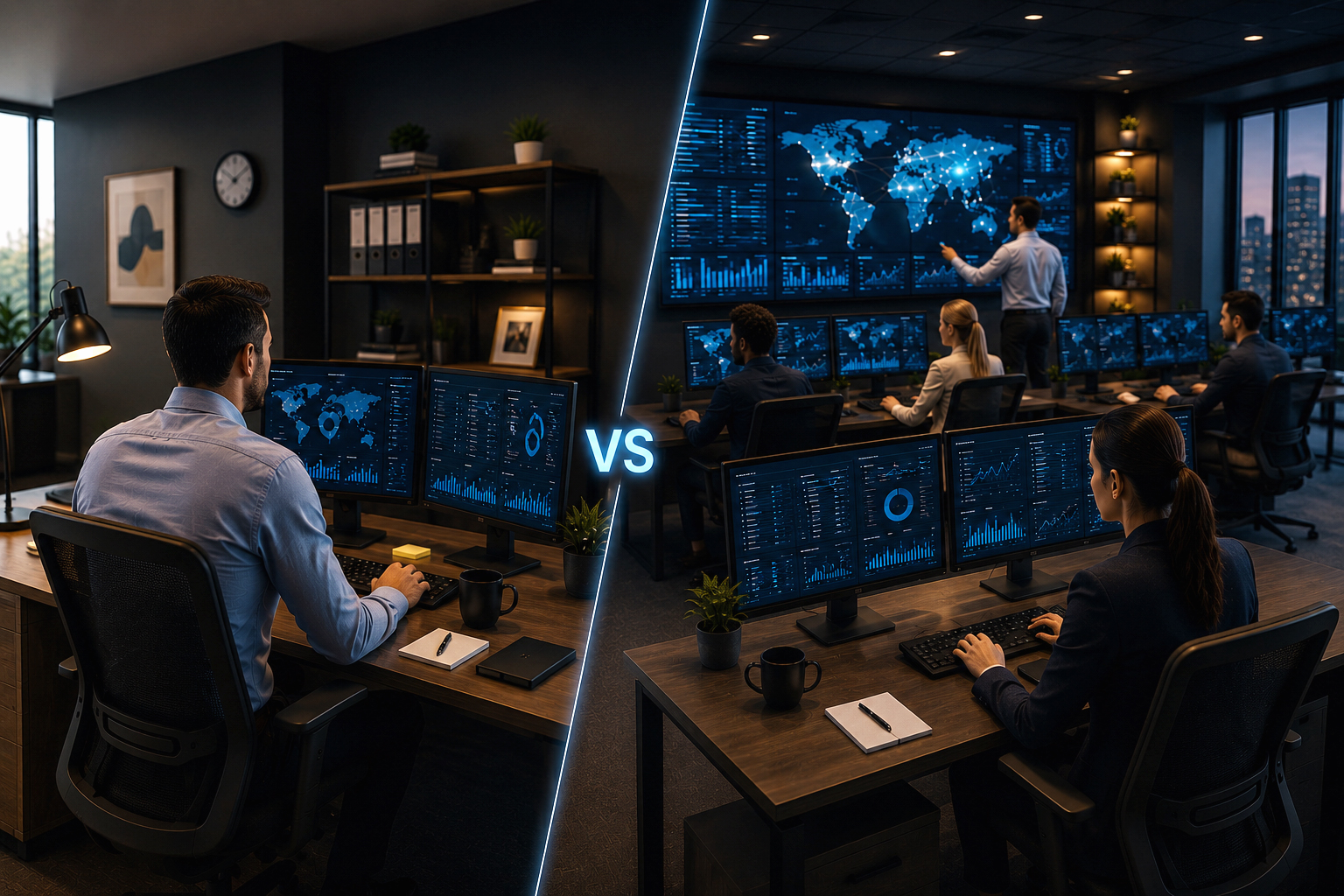
Managed Security Services vs. In-House SOC: An Honest Cost and Risk Comparison
Managed security services vs. in-house SOC refers to the decision between outsourcing your security operations to a third-party provider (an MSSP) or building and staffing a dedicated internal team. For most mid-market organizations with 200 to 2,000 employees, a managed security services provider delivers equivalent or better coverage at 25 to 40 percent of the ... Read more
Managed security services vs. in-house SOC refers to the decision between outsourcing your security operations to a third-party provider (an MSSP) or building and staffing a dedicated internal team. For most mid-market organizations with 200 to 2,000 employees, a managed security services provider delivers equivalent or better coverage at 25 to 40 percent of the ... Read more
Read full post on meriplex.com

AI Acceptable Use Policy: 5 Things It Must Actually Cover
An AI acceptable use policy for businesses defines the rules governing how employees may use artificial intelligence tools—which tools are sanctioned, what data can be shared with them, what employees are responsible for, and what happens when something goes wrong. When written well, it gives leadership something defensible, security teams something they can monitor, and ... Read more
An AI acceptable use policy for businesses defines the rules governing how employees may use artificial intelligence tools—which tools are sanctioned, what data can be shared with them, what employees are responsible for, and what happens when something goes wrong. When written well, it gives leadership something defensible, security teams something they can monitor, and ... Read more
Read full post on meriplex.com
Managed Security Services vs. In-House SOC: An Honest Cost and Risk Comparison
TEXT BOX H2 TITLE H3 TITLE QUOTATION BOX CTA Get My Gap Assessment
TEXT BOX H2 TITLE H3 TITLE QUOTATION BOX CTA Get My Gap Assessment
Read full post on meriplex.com

MSSP Services: The Complete Guide
Mid-market businesses are increasingly in the crosshairs of ransomware groups, supply chain attacks, and threat actors once focused exclusively on large enterprises. The problem isn’t awareness—most IT leaders understand the risk. The problem is capacity: a 24/7 security operation requires people, technology, and process that most organizations at the 100-to-1,000-employee scale simply can’t staff or ... Read more
Mid-market businesses are increasingly in the crosshairs of ransomware groups, supply chain attacks, and threat actors once focused exclusively on large enterprises. The problem isn’t awareness—most IT leaders understand the risk. The problem is capacity: a 24/7 security operation requires people, technology, and process that most organizations at the 100-to-1,000-employee scale simply can’t staff or ... Read more
Read full post on meriplex.com

Managed IT Services for Healthcare: The Complete Guide
Healthcare is the most-breached industry in the United States for the fourteenth consecutive year. According to IBM’s 2024 Cost of a Data Breach Report, the average healthcare data breach costs $9.77 million, more than twice the cross-industry average. The organizations absorbing those costs are not the ones that skipped security. They are mid-market health systems, ... Read more
Healthcare is the most-breached industry in the United States for the fourteenth consecutive year. According to IBM’s 2024 Cost of a Data Breach Report, the average healthcare data breach costs $9.77 million, more than twice the cross-industry average. The organizations absorbing those costs are not the ones that skipped security. They are mid-market health systems, ... Read more
Read full post on meriplex.comFailed to load more articles
You're all caught up!
Check back later for more profile news.

As a trusted partner, we deliver business-driven solutions that provide the scalability and support needed to power enterprise growth.
Meriplex provides managed solutions for Intelligent WAN, Cybersecurity, Physical Security, and Cloud and Voice.
Managed IT Services for Senior Living: The Complete Guide for Community Administrators
Ask five senior living administrators who’s responsible for cybersecurity at their community, and at least three will point to someone whose actual job has nothing to do with IT. The budget goes to caregivers first, and technology gets handled by whoever has room for one more task. Managed IT services for senior living means a ... Read more
Ask five senior living administrators who’s responsible for cybersecurity at their community, and at least three will point to someone whose actual job has nothing to do with IT. The budget goes to caregivers first, and technology gets handled by whoever has room for one more task. Managed IT services for senior living means a ... Read more
Read full post on meriplex.com
Why Being HIPAA Compliant Doesn’t Mean You’re Insurable
Your HIPAA risk assessment is current. Your policies are signed, your Business Associate Agreements are on file, and your last OCR review came back clean. Then your cyber insurance renewal application lands on your desk, and the underwriter wants proof of phishing-resistant multi-factor authentication on every system, endpoint detection and response on every device, and ... Read more
Your HIPAA risk assessment is current. Your policies are signed, your Business Associate Agreements are on file, and your last OCR review came back clean. Then your cyber insurance renewal application lands on your desk, and the underwriter wants proof of phishing-resistant multi-factor authentication on every system, endpoint detection and response on every device, and ... Read more
Read full post on meriplex.com
What Is a Private AI Enclave and Do You Need One?
Your finance team is uploading vendor contracts into ChatGPT to summarize them. Your sales team is pasting client data into Gemini to draft proposals faster. And somewhere in a vendor call this quarter, someone floated the phrase “private AI enclave” as the fix—leaving your IT director unsure whether that’s an actual deployment or a sales ... Read more
Your finance team is uploading vendor contracts into ChatGPT to summarize them. Your sales team is pasting client data into Gemini to draft proposals faster. And somewhere in a vendor call this quarter, someone floated the phrase “private AI enclave” as the fix—leaving your IT director unsure whether that’s an actual deployment or a sales ... Read more
Read full post on meriplex.com
5 Signs Your AI Adoption Has Outpaced Your Security Team
Somewhere in your organization right now, someone is pasting a client contract into ChatGPT to get a faster summary. Nobody approved the tool. Nobody classified the data. And if your security team can’t tell you what happens next, your AI adoption has already outpaced your ability to govern it. Unmanaged AI adoption is what happens ... Read more
Somewhere in your organization right now, someone is pasting a client contract into ChatGPT to get a faster summary. Nobody approved the tool. Nobody classified the data. And if your security team can’t tell you what happens next, your AI adoption has already outpaced your ability to govern it. Unmanaged AI adoption is what happens ... Read more
Read full post on meriplex.com
Co-Managed IT Services: The Complete Guide for Mid-Market IT Directors
Most mid-market IT directors are not looking to hand their environment to an outside firm. They are looking for a way to close specific gaps without losing the institutional knowledge their team has spent years building. Co-managed IT services is the model built for that exact situation. This guide covers how co-managed IT works, what it costs, ... Read more
Most mid-market IT directors are not looking to hand their environment to an outside firm. They are looking for a way to close specific gaps without losing the institutional knowledge their team has spent years building. Co-managed IT services is the model built for that exact situation. This guide covers how co-managed IT works, what it costs, ... Read more
Read full post on meriplex.com
Managed Security Services vs. In-House SOC: An Honest Cost and Risk Comparison
Managed security services vs. in-house SOC refers to the decision between outsourcing your security operations to a third-party provider (an MSSP) or building and staffing a dedicated internal team. For most mid-market organizations with 200 to 2,000 employees, a managed security services provider delivers equivalent or better coverage at 25 to 40 percent of the ... Read more
Managed security services vs. in-house SOC refers to the decision between outsourcing your security operations to a third-party provider (an MSSP) or building and staffing a dedicated internal team. For most mid-market organizations with 200 to 2,000 employees, a managed security services provider delivers equivalent or better coverage at 25 to 40 percent of the ... Read more
Read full post on meriplex.com
AI Acceptable Use Policy: 5 Things It Must Actually Cover
An AI acceptable use policy for businesses defines the rules governing how employees may use artificial intelligence tools—which tools are sanctioned, what data can be shared with them, what employees are responsible for, and what happens when something goes wrong. When written well, it gives leadership something defensible, security teams something they can monitor, and ... Read more
An AI acceptable use policy for businesses defines the rules governing how employees may use artificial intelligence tools—which tools are sanctioned, what data can be shared with them, what employees are responsible for, and what happens when something goes wrong. When written well, it gives leadership something defensible, security teams something they can monitor, and ... Read more
Read full post on meriplex.com
Managed Security Services vs. In-House SOC: An Honest Cost and Risk Comparison
TEXT BOX H2 TITLE H3 TITLE QUOTATION BOX CTA Get My Gap Assessment
TEXT BOX H2 TITLE H3 TITLE QUOTATION BOX CTA Get My Gap Assessment
Read full post on meriplex.com
MSSP Services: The Complete Guide
Mid-market businesses are increasingly in the crosshairs of ransomware groups, supply chain attacks, and threat actors once focused exclusively on large enterprises. The problem isn’t awareness—most IT leaders understand the risk. The problem is capacity: a 24/7 security operation requires people, technology, and process that most organizations at the 100-to-1,000-employee scale simply can’t staff or ... Read more
Mid-market businesses are increasingly in the crosshairs of ransomware groups, supply chain attacks, and threat actors once focused exclusively on large enterprises. The problem isn’t awareness—most IT leaders understand the risk. The problem is capacity: a 24/7 security operation requires people, technology, and process that most organizations at the 100-to-1,000-employee scale simply can’t staff or ... Read more
Read full post on meriplex.com
Managed IT Services for Healthcare: The Complete Guide
Healthcare is the most-breached industry in the United States for the fourteenth consecutive year. According to IBM’s 2024 Cost of a Data Breach Report, the average healthcare data breach costs $9.77 million, more than twice the cross-industry average. The organizations absorbing those costs are not the ones that skipped security. They are mid-market health systems, ... Read more
Healthcare is the most-breached industry in the United States for the fourteenth consecutive year. According to IBM’s 2024 Cost of a Data Breach Report, the average healthcare data breach costs $9.77 million, more than twice the cross-industry average. The organizations absorbing those costs are not the ones that skipped security. They are mid-market health systems, ... Read more
Read full post on meriplex.comFailed to load more articles
You're all caught up!
Check back later for more profile news.