Managed Service Providers in Florida, USA
Page 2 of 12










Managed IT Services in Plant City, FL: Local IT Support That Keeps Business Moving
Plant City businesses depend on technology for nearly every part of the workday. Employees need reliable computers, secure access to files, working email and a network that does not slow down when business gets busy. When any one of those systems fails, orders can be delayed, customers may be left waiting and employees lose productive
Plant City businesses depend on technology for nearly every part of the workday. Employees need reliable computers, secure access to files, working email and a network that does not slow down when business gets busy. When any one of those systems fails, orders can be delayed, customers may be left waiting and employees lose productive
Read full post on tampapcconsultants.com
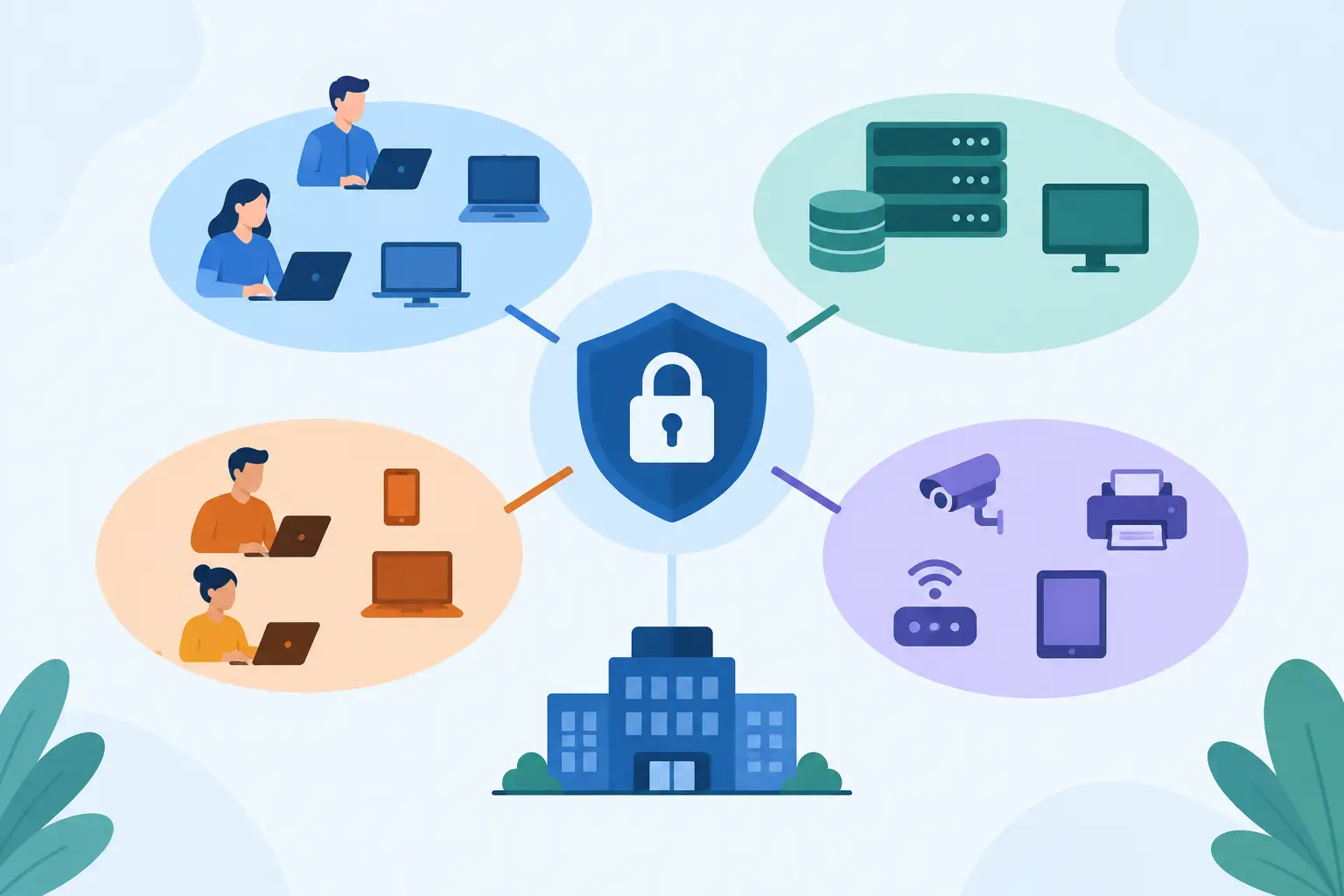
Business Network Segmentation Guide for SMBs
A business network segmentation guide for Southwest Florida companies that want to limit cyber risk, protect operations, and keep staff productive daily.
A business network segmentation guide for Southwest Florida companies that want to limit cyber risk, protect operations, and keep staff productive daily.
Read full post on priscanova.com


Storm-Tested Infrastructure: Building IT That Holds Up When the Power Doesn't
Storm-tested IT infrastructure means geographic data redundancy, tested failover systems, verified backups, and a communications plan you can execute without power or internet. The decisions that protect your business have to be made before the storm, not during it. What the Storm Data Actually Says About Business Survival Here's the number that doesn't get enough attention: 40% of small businesses never reopen after a natural disaster.1 And of those that do manage to get back up, another 25% close permanently within the following year.1 That's not a technology statistic. That's a survivab
Storm-tested IT infrastructure means geographic data redundancy, tested failover systems, verified backups, and a communications plan you can execute without power or internet. The decisions that protect your business have to be made before the storm, not during it. What the Storm Data Actually Says About Business Survival Here's the number that doesn't get enough attention: 40% of small businesses never reopen after a natural disaster.1 And of those that do manage to get back up, another 25% close permanently within the following year.1 That's not a technology statistic. That's a survivability statistic. The Southeast Coast bears an outsized share of this risk. Small businesses make up 84.3% of all establishments along the southeastern coastline2 — and during 2017's back-to-back hurricane season, three storms (Harvey, Irma, and Maria) accounted for 92% of all small business disaster losses nationwide.2 Florida isn't a footnote in this story. Florida is the story. The good news: these are not random acts of fate. They are largely the result of IT decisions — or the lack of them — made long before the first tropical depression forms in the Atlantic. What Does Storm-Ready IT Infrastructure Actually Look Like? "Storm-ready" isn't a product you buy. It's an architectural posture — a set of layered decisions about where your data lives, how your systems fail over, and what your team does when the power goes out. The foundation rests on three pillars: 1. Geographic data redundancy. Your data should never live in only one physical location. Cloud backups stored in geographically separate data centers ensure that even if your office — and your local data center — takes a direct hit, your information survives. The 3-2-1 rule remains the baseline: three copies of your data, on two different media types, with one stored off-site. 2. Verified, tested backups. A backup that has never been restored is a theory, not a protection. Industry data shows that 58% of data backups fail when it counts.3 The test isn't whether the backup ran — it's whether the restore worked. If you haven't verified a full recovery recently, you don't actually have a backup plan. 3. Documented failover systems. Failover is the process that keeps your business running when primary systems go down. That might mean secondary internet connections (cellular backup or a second ISP), cloud-hosted phone systems that route calls when your office is offline, or a defined remote-work protocol that activates automatically when the building is inaccessible. The IT Decisions You Can't Make After Landfall This is the section that matters most. There is a category of IT decision that has a hard deadline — and that deadline is whenever the National Hurricane Center upgrades the advisory to a watch. After that point, you're executing a plan. You're not building one. Before the season peaks — ideally before June, certainly before September — your team should have confirmed: Cloud backup is active, automated, and the most recent restore has been tested Critical systems can be accessed remotely, and your team knows how Your internet failover (secondary connection or cellular) is operational Employee contact lists, vendor contacts, and client notification templates are documented and accessible offline Your IT provider has your emergency contact protocol and a defined response SLA for post-storm situations Hardware critical to operations (laptops, external drives) has a pre-storm relocation plan Only 54% of organizations have a documented disaster recovery plan.3 If your business is in the other 46%, that gap is the risk. Not the storm. How Do You Actually Test Failover Before a Storm? Testing failover sounds complicated. It isn't. It requires intention and a calendar, not a big IT budget. Start with a tabletop exercise: gather your key stakeholders, define a scenario ("It's 48 hours after a Category 3 landfall. Your office has no power and no internet."), and walk through every system and process. Who calls whom? How does payroll run? How do clients reach you? Where is your data? From there, escalate to a live drill. Actually fail over to your backup internet connection. Actually restore data from your cloud backup. Actually test remote access for every role that needs it. What fails in a drill costs you an afternoon. What fails during a storm costs you your business. If your managed IT provider isn't conducting these exercises with you — or can't tell you the last time your backups were verified — that's a conversation worth having now. Don't Forget the IT Asset You're Most Likely to Overlook Infrastructure gets the attention. Communications plans don't. After a major hurricane, cell towers are degraded, landlines are unreliable, and internet service can be out for days or weeks. Your ability to reach employees, vendors, and clients in those first 72 hours will define your recovery trajectory as much as any technical system. Before peak season, build and distribute a communications plan that answers: How will you notify employees about office status? Who is the primary point of contact for clients, and what's the backup if that person is unreachable? What's your protocol for communicating a service disruption to customers? How will your team coordinate if messaging apps and email are down? A printed contact sheet stored off-site. A pre-drafted client notification email ready to send from a mobile hotspot. A designated off-state contact who can relay messages. These aren't sophisticated IT solutions — they're the unglamorous details that separate businesses that recover quickly from those that don't. Is Your IT Ready for Peak Season? September 18 is statistically one of the most active weeks of Atlantic hurricane season. If you're reading this and you're not confident your infrastructure would hold up, that confidence gap is the most important thing on your to-do list this week. Sentry Technology Solutions works with Florida businesses to build, test, and maintain the IT infrastructure and continuity plans that don't just survive storm season — they keep operations running through it. Start with a conversation. Talk to Sentry About Your Business Continuity Plan → sentryitsolutions.com References 1. Federal Emergency Management Agency (FEMA). Small business disaster recovery statistics. Cited via IWINS and Access Corp. https://www.iwins.com/blog/fema-over-one-third-of-small-businesses-do-not-reopen-after-a-disaster/ 2. U.S. Small Business Administration Office of Advocacy. "The Eye of the Storm: Small Businesses and Natural Disasters." October 2024. https://advocacy.sba.gov/wp-content/uploads/2024/10/Small-Businesses-and-Natural-Disasters_FINAL.pdf 3. Computing Research (2021) and Veeam (2021). Cited via Invenio IT Disaster Recovery Statistics. https://invenioit.com/continuity/disaster-recovery-statistics/
Read full post on sentrytechsolutions.com


Do I Need an IT Person or a Managed IT Company?
Your business has reached a point where somebody needs to take responsibility for IT. Congratulations. And also… now what? Do you hire an IT person? Do you outsource everything to
Your business has reached a point where somebody needs to take responsibility for IT. Congratulations. And also… now what? Do you hire an IT person? Do you outsource everything to
Read full post on digitalboardwalk.com



When Should a Business Upgrade From Microsoft 365 Business Standard to Premium?
Schedule a Microsoft 365 review: when should a business upgrade from Microsoft 365 Business Standard to Premium? Compare security, devices, and compliance.
Schedule a Microsoft 365 review: when should a business upgrade from Microsoft 365 Business Standard to Premium? Compare security, devices, and compliance.
Read full post on igtech365.com


Speed Techs Actually Feel: How ROI Technology Runs Faster on Syncro
Hear how ROI Technology switched to Syncro for speed and a unified RMM and PSA. See how better performance gives technicians their time back.
Hear how ROI Technology switched to Syncro for speed and a unified RMM and PSA. See how better performance gives technicians their time back.
Read full post on syncrosecure.com
AI Is Changing Cyberattacks: Is Your Credit Union Ready?
Introduction Everyone is talking about how AI can improve productivity, streamline operations, and enhance member experiences. Far fewer are talking about how AI is making cybercriminals faster, more convincing, and easier to scale. For credit unions, this is not simply a technology concern. These institutions depend on trusted member relationships, handle sensitive financial data, work…
Introduction Everyone is talking about how AI can improve productivity, streamline operations, and enhance member experiences. Far fewer are talking about how AI is making cybercriminals faster, more convincing, and easier to scale. For credit unions, this is not simply a technology concern. These institutions depend on trusted member relationships, handle sensitive financial data, work…
Read full post on integrisit.com


MSP Onboarding and the First 30 Days That Decide Retention
When an MSP decides against adding a new service line, the reason given is usually market demand. That reason rarely survives a second look. Most providers believe they could sell the thing. What stops them is the picture of twenty clients cutting over in the same quarter, a help desk of two, and every migration going sideways at once.
When an MSP decides against adding a new service line, the reason given is usually market demand. That reason rarely survives a second look. Most providers believe they could sell the thing. What stops them is the picture of twenty clients cutting over in the same quarter, a help desk of two, and every migration going sideways at once.
Read full post on ringlogix.com
What an Outage Actually Costs Your Practice
There is a comfortable story a lot of small business owners tell themselves about downtime. If the systems ever go down, we will just roll up our sleeves and deal
There is a comfortable story a lot of small business owners tell themselves about downtime. If the systems ever go down, we will just roll up our sleeves and deal
Read full post on dpctechnology.com

Ransomware Protection: Why Backup Alone Is Not a Recovery Strategy
Many businesses have backups. Fewer of them can confidently answer what would actually happen if ransomware encrypted their production environment tomorrow morning. That gap, between having a backup and knowing with certainty that it works, is where recovery plans quietly fail, usually at the exact moment a business can least afford it.
Many businesses have backups. Fewer of them can confidently answer what would actually happen if ransomware encrypted their production environment tomorrow morning. That gap, between having a backup and knowing with certainty that it works, is where recovery plans quietly fail, usually at the exact moment a business can least afford it.
Read full post on kairosit.com